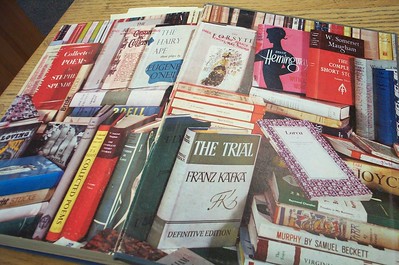
"Concise Encyclopedia of World Literature" by Reeding Lessons is licensed under CC BY-NC-SA 4.0
Literature and Society
This course addresses the richness of Mauritian Literature and Society through a 10-week course, delving into a diverse array of texts that illuminate the cultural, historical, and social fabric of Mauritius. This immersive literary journey blends traditional lectures with interactive discussions, analyzing seminal works from celebrated Mauritian authors. The course begins by establishing the societal context through different literature roles, examining the island's multiethnic and multilingual backdrop, which shapes its unique literary voice. Enlightening lectures highlight the influence of colonial and postcolonial narratives, while seminars encourage debates on identity, migration, indentured and Creole dynamics.
Learners are introduced to prominent figures like Dev Virahsawmy, whose works challenge linguistic barriers, and Khal Torabully, whose poetry elegantly confronts indenturedship. The curriculum covers an array of genres including poetry and plays, reflecting the creolization and indenturedship process and their impact on literary plot. Weekly reading assignments and critical analyses will build learners' understanding of literary devices used to express socio-political issues. Capstone projects encourage deep exploration of specific themes or authors, fostering a personalized connection with the material. Ultimately, this equips learners with a nuanced critical outlook of Mauritian Literature.
Learning Objectives:
The learners in this course are expected to be able to:
- Analyse the interplay of language, culture, and identity in Mauritian literature.
- Critically evaluate the representations of colonial and postcolonial experiences in Mauritian literary works.
- Synthesize perspectives from a diverse range of Mauritian authors and texts to create a multifaceted view of Mauritian society.
- Produce a scholarly analysis of themes such as transoceanic dialogues, race dynamics, and societal change within the island's distinctive literary oeuvre.
- Write a research project based on a chosen text of Mauritian Literature and Society that showcases culture and identity.
Assessment Schemes
- Formative Assessment: 40% (face to face) (LMS-Enabled Assessment)
- Summative Assessment: 60%
Download module catalogue (opens in new window)
Course Facilitator
Mrs Anisha Badal-Caussy
Email: anisha.badal@mgi.ac.mu
- Teacher: Anisha Badal-Caussy
A two-week course on Artificial Intelligence in Higher Education provides educators, administrators, and IT professionals with an in-depth understanding of AI's transformative potential in academic settings. Participants will explore AI's fundamental concepts, including machine learning, natural language processing, and neural networks, tailored explicitly towards educational applications.
- Teacher: MGI Admin
- Teacher: Preeti Boyjonauth-Shamboo
Introduction to AI Tools for Public Relations
This 2-week intensive course delves into the cutting-edge integration of Artificial intelligence within the Public Relations sector, equipping professionals and students with the necessary insights and hands-on experience to transform their communication strategies. The learners will explore AI-driven analytics, content creation, and stakeholder engagement. Additionally, the curriculum includes ethical considerations, crisis management enhancements, and predictive media monitoring, ensuring that the learners master both the operational and strategic applications of AI in public relations. This course is designed for those seeking to future-proof their skills and enhance their competitive edge in a rapidly evolving digital landscape.
- Teacher: MGI Admin
- Teacher: Anjuli Bajnath
This course has been developed to guide institutions, faculty members, instructional designers, and academic professionals in developing quality blended learning courses to enhance the learning experience. It will provide the principles of blended learning, which integrates traditional face-to-face instruction with online educational technologies and it covers the necessary elements to create an effective blended learning environment.
- Teacher: Dr Anjusha Durbarry